Palm lines are interpreted in different schools (Indian, Chinese, Greek, and eclectic Western hybrids). Tradition links line quality — depth, length, forks — to habitual emotional and cognitive patterns.
Which hand to read
Most palmists read both hands. In the common Western approach, the hand you write with shows how you live now, while the other hand shows the tendencies you started with; some Indian traditions instead read the right hand for men and the left for women. Either way, the comparison is the useful part, because the places where your two hands differ point to habits you've built or changed.
How to read your palm
Hold your hand open with the fingers together, in even light, and work through it in order:
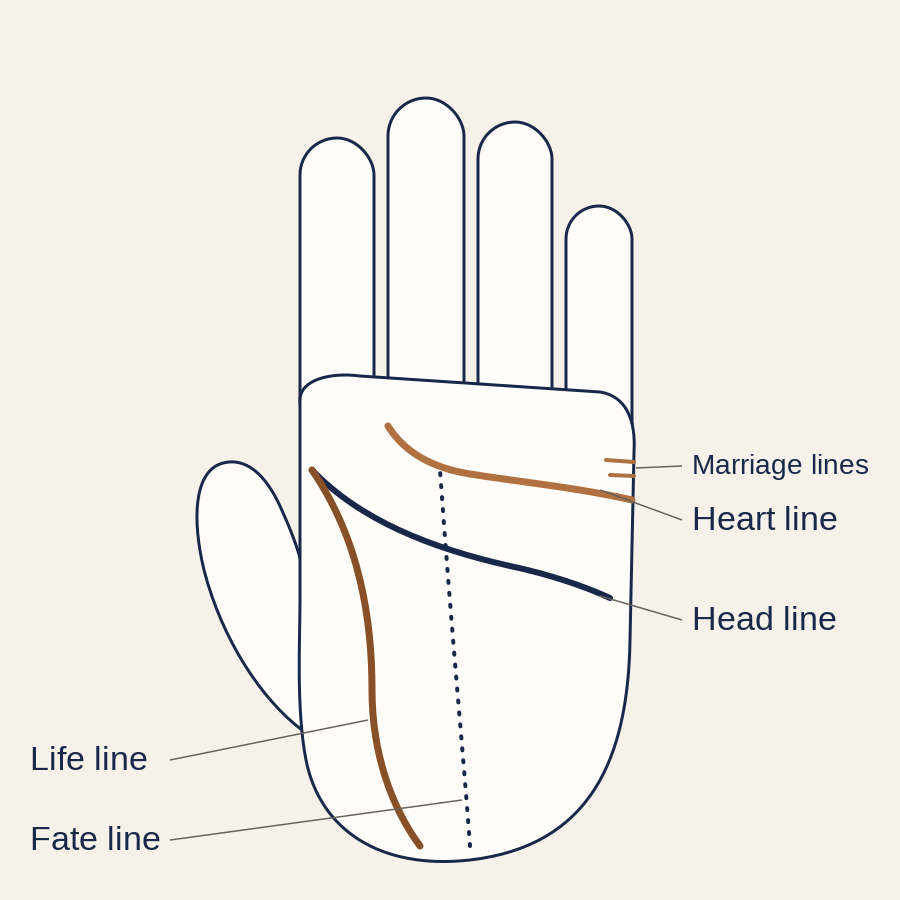
- Find the main lines. The heart line runs across the top of the palm under the fingers, the head line across the middle, and the life line curves around the base of the thumb. The fate line, if you have one, runs up the centre toward the middle finger.
- Look at each line's length and depth. Tradition reads a deep, clear line as a strong, steady trait and a faint one as a quieter influence.
- Note breaks, forks, chains and islands (small loops along a line). These are read as changes or periods of strain in that area of life, never as events with dates.
- Compare both hands.
Heart line
Symbolic focus is on bonding: how affection is exchanged, guarded, overflowed, or repaired. Readers look at curvature toward fingers, fragmentation, islands, or strength of trace — not omens.
The heart line runs across the top of the palm, and where it ends matters most. Reaching up toward the index finger is traditionally read as high ideals and contentment in love; ending under the middle finger, as someone who puts their own needs first in relationships. A line that runs straight across suggests feelings kept practical and private, and a strongly curved one suggests emotions expressed openly.
Head line
Associated with focus style: linear versus wandering thought, pragmatism versus imagination. A long sweeping line differs in metaphor from one that stops mid-palm.
It starts between the thumb and index finger. A straight line is read as logical, step-by-step thinking, and one that slopes down toward the wrist as imagination and creative problem-solving. When the head line begins joined to the life line, tradition reads caution in early life; a clear gap between the two suggests independence from a young age.
Life line
Popular culture mislabels this as lifespan. Classical palmistry relates it more to stamina, pivots, and major chapters — elasticity under stress.
The life line begins near the head line and curves around the ball of the thumb. A wide curve is read as energy and enthusiasm, and a line that hugs the thumb as a more measured pace. A break is read as a change of direction or way of living. A second line running alongside it, sometimes called a sister line, is read as support during demanding periods.
Fate line
The fate line runs up the centre of the palm toward the middle finger, and many hands have only a faint one or none at all. That's ordinary: tradition reads a missing fate line as a life shaped by choice rather than by one fixed path. Where the line exists, palmists link it with work and direction. Starting low near the wrist, it's read as an early sense of purpose; starting higher up the palm, as a direction found later. A fate line that rises from the life line suggests a path built through your own effort, while one that starts from the outer edge of the palm suggests a path shaped by other people's support.
Marriage lines
Marriage lines, also called relationship or affection lines, are the short horizontal lines on the edge of the palm between the base of the little finger and the heart line. Tradition reads them as significant emotional bonds, not only marriages, and a deep line as a lasting one. They don't count marriages, give dates or settle whether two people will stay together.
A grounded approach
Naksh combines palm symbolism with questionnaires so guidance stays personal. We avoid medical diagnoses or alarmist shorthand; symbolism should empower reflection, not fear.
If you'd like your own lines read, our online palm reading works from a clear photo of each palm.